
Two new exciting exhibitions are on display at Edinburgh Futures Institute from February to March 2026, showcasing cutting-edge digital art and immersive storytelling.
Both exhibitions explore how digital technologies can reshape the ways we encounter history, culture and the natural world.
Living Lithographs
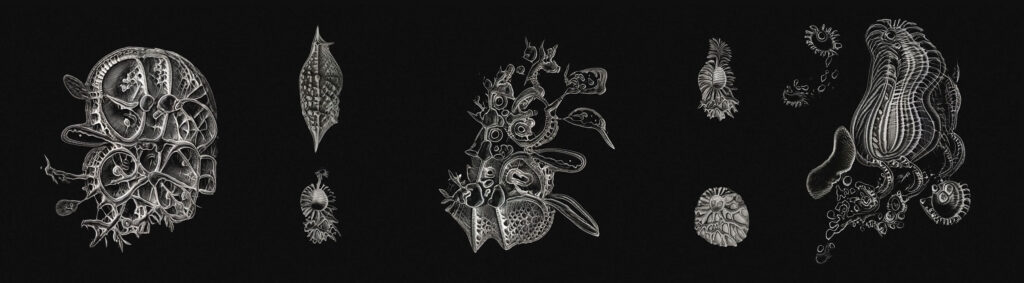
On display on the large digital screen at Level 2 near the clocktower entrance is the Living Lithographs exhibition, created by Lindsey Carr.
Originally developed as a tool for the creation of a series of lithographs based on Ernst Haeckel’s ‘Kunstformen Der Natur’, the tool has now been reformatted for display on the Futures Institute’s digital screen.
Organisms on screen are generated by machine learning and animated using latent space interpolation to calculate the best trajectory between each.
The exhibit is co-commissioned by Aberdeen Performing Arts and New Media Scotland’s Alt-w Fund with investment from Creative Scotland and the University of Edinburgh.
Living Lithographs will be on display from February to March 2026.
Immersive Calanais: Past, Present and Future
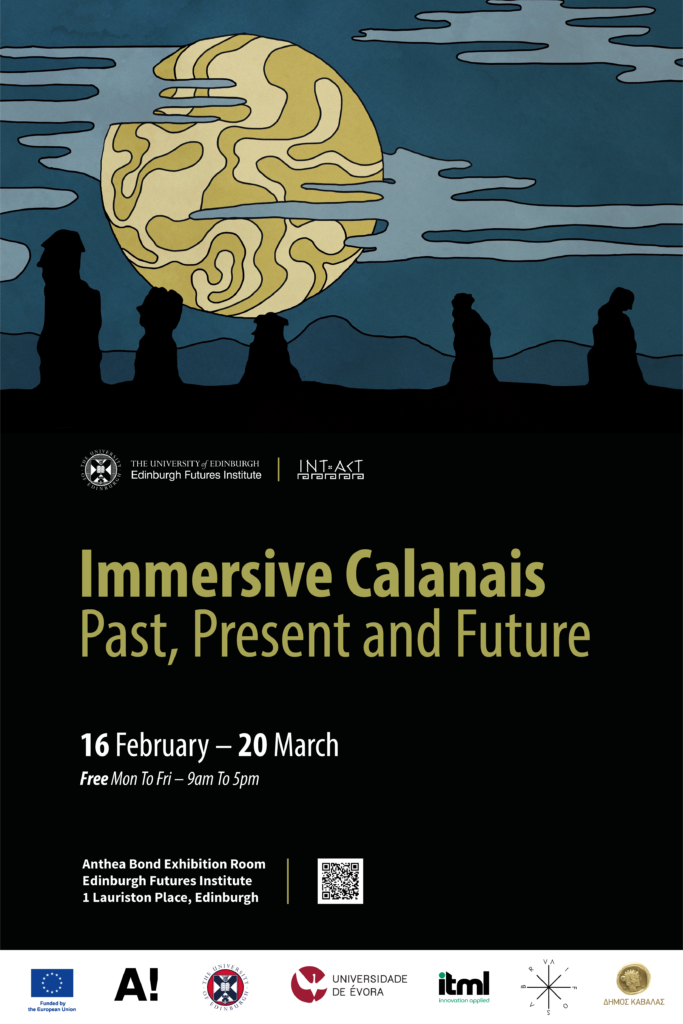
Another exhibition now available to view at the Institute is Immersive Calanais: Past, Present, Future, an immersive exhibition inviting visitors to experience the Calanais standing stones (Scotland).
The exhibit explores the stone circles of Calanais as part of a living relationship between people and place. Rather than focusing only on the stones themselves, the project brings forward the intangible stories and experiences that continue to shape this landscape today.
Throughout the exhibition, visitors are invited to engage with a digital app featuring images, stories, animations and augmented reality, offering layered ways to explore the site.
Alongside this, they can handle materials drawn from the landscape — including stone, organic elements and crafted objects— offering a tactile way to connect with place, memory and lived experience.
The interactive tablet-based application has been developed as part of the INT-ACT project (Intangible Cultural Heritage: Bridging the Past, Present and Future), a European project that explores how we can experience and share the contemporary living stories behind cultural heritage sites
Immersive Calanais also forms part of an ongoing participatory research project.
Participants aged 30yo or under and 60yo or older are invited to take part in a two-day intergenerational research activity exploring experiences, stories, and relationships connected to Calanais.
The Immersive Calanais exhibition is located at the Anthea Bond Exhibition Room on Level 1 until 20 March 2025.
More exciting exhibitions exploring digital and generative artworks will be launched at the Institute’s creative spaces throughout the year.
Related links
If you are interested in taking part or would like more information about the Immersive Calanais participatory project, please contact anunezg@ed.ac.uk or fill in this form.