The programme focused on how organisations, systems, and people learn and change profoundly affects our lives, our surroundings, and our futures.
This pioneering programme responded to the need for creative, critical and experimental thinking across education in schools, universities, colleges, communities, industries and organisations.
Students examined issues such as:
- Global change: the intersection of education with migration, conflict, health, the climate crisis and worldwide transformations
- Social justice and mobility: promoting equity, inclusion and challenging disadvantage
- Culture: how creativity, society and cultural contexts influence learning
- Data-driven systems: how AI and digital technologies reshape teaching and knowledge
- Politics: the impact of policy, power and ideology on learning systems
- Future of work and creativity: how education shapes skills, innovation and adaptability in changing economies
Students learned to think critically and ambitiously about the future of education, and gained valuable data and creative skills for their careers, developing the ability to influence policy, practice and debate at local and global levels, and engage with the ethical, cultural and environmental responsibilities of educational design.
Dr Seongsook Choi, is a Senior Lecturer and Head of Institute of Education, Community and Society in the Moray House School of Education and Sport.
Find out more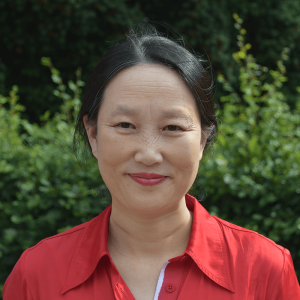
Professor Jen Ross is Personal Chair of Digital Culture and Education Futures, co-director of the Centre for Research in Digital Education, and Associate Dean (Research Cultures) in the College of Arts, Humanities and Social Sciences.
Find out more
“Studying and researching education futures means thinking about how education is shaped by society and politics, by culture, by climate crisis, by all kinds of factors that mean that education will look quite different in the future than it does now. It also means considering education’s vital role in shaping the future.”
Dr Jen Ross, Programme Co-Director, MSc Education Futures, Edinburgh Futures Institute
This programme was part of our interconnected postgraduate study options, focused on complex global and social challenges.
Students learned from academic experts from different subject areas, and developed creative, critical and data-informed thinking that cut across traditional academic boundaries. Students had the space to think deeply about questions linked to their own passions and professional goals, and to develop a final project based on an issue that they cared about.
This programme was designed for proactive and motivated students passionate about tackling real-world issues. Students graduated equipped to work on complex problems that require critical thinking, novel approaches, teamwork, and collaboration. This programme was for recent graduates and career professionals from a diverse range of backgrounds, areas of study and skill sets.
Core elements:
- Data skills: collecting, managing, using and analysing data ethically and critically.
- Critical concepts, methods and principles: examining and understanding education’s role in shaping and responding to global challenges and social, political, cultural, and environmental change, as well as how global processes shape education.
- Links between education and data-driven innovation: the geographies, mobilities, values, ethics, and measurement that accompany innovation, resistance to, and reliance on data.
- Creative problem solving and specialist skills: innovative, collaborative, analytic, data-led and creative approaches to understand and explore possible futures for formal and informal education.
- Cross-disciplinary insights: approaching and analysing challenges and issues from multiple perspectives and different viewpoints in order to address societal challenges relating to education futures.
Programme highlights
Students studied a range of compulsory and optional courses, along with a final project, to complete 180 credits.
An interdisciplinary programme can help your career and future employability.
This programme helped students develop their career regardless of whether their interests were in policy, learning design, teaching and delivery, or educational research.
This programme was of particular interest to those preparing for or beginning leadership roles where a focus on developing future educational provision, policy, technologies and practices is key.
The programme was aimed at both professionals and graduates who were in, or seeking to build a career in, either formal or informal learning and training sectors.
Potential future opportunities included education-related roles in:
- Higher education
- Further education
- Community and cultural settings
- Schools
- Training organisations
- Private, government and voluntary sectors