
Featured Image: Edinburgh Futures Institute Art Workshop. Photograph by Masahiko Hara
A collaborative art workshop led by former Edinburgh Futures Institute Visiting Fellow Dr Miranda Anderson has brought students and staff together to explore creativity and innovation, with their artwork and reflections featured in a report which was published in May 2026.
The joint report, Fission-Fusion Perspectives and Complex Issues, published by the Japan Society for the Promotion of Science (JSPS) with the Royal Society of Edinburgh (RSE) highlights a collaborative artwork co-created by Edinburgh Futures Institute researchers and students as part of an international exploration of creativity, innovation and collective knowledge.
The publication emerged from a symposium organised by Dr Anderson to mark 30 years of JSPS activity in the UK and the renewal of its partnership with the Royal Society of Edinburgh. The report brings together diverse individual, disciplinary and societal perspectives to consider ways of tackling complex issues through imagining and motivating the creation of alternatives to our current reality.
Dr Anderson is Honorary Fellow in Philosophy at the University of Edinburgh and was a Visiting Fellow at Edinburgh Futures Institute from September 2024 until February 2025.
A Fission-Fusion Framework
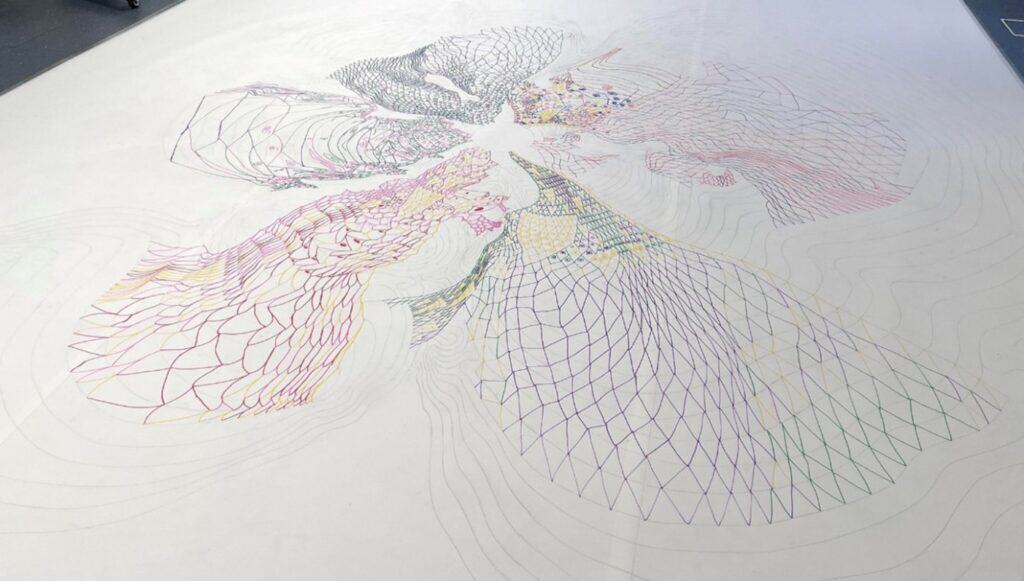
Alongside the symposium, Dr Anderson worked with Tokyo-based artist Goro Murayama to develop “Fission-Fusion Evolution”, a collaborative artwork that invited participants to explore how creativity emerges through interaction, shared structures and collective imagination.
Dr Anderson said:
“The term ‘fission-fusion’ describes the merging and diverging of aspects of our minds and selves with aspects of the world around us, illuminating the significance of our interconnectedness and differences. Who we are as human beings is dependent on the world around us and those who came before us: this is something you can grasp just by taking a look around yourself! We can share understandings as we are all embodied and part of natural, linguistic, cultural, and technological environments, and through our diversities we can contribute distinctive insights. The fission-fusion framework is humbling and empowering by reminding us of our indebtedness, responsibility and capacity to co-create our unfolding reality.”
To bring the fission-fusion framework into practice, Dr Anderson partnered with Murayama to lead a workshop in the Edinburgh Futures Institute involving students from the MA in Interdisciplinary Futures programme and Futures Institute staff members, supported by Makerspace Specialist Technician Peter Bentley.
The artwork combined artistic practice with ideas drawn from computing, biology and philosophy. Participants worked within a circular maze designed by Murayama, creating colourful cellular patterns inspired by cellular automata – mathematical systems that generate complex forms from simple rules. Working from a shared centre point, participants each selected three colours representing the past, present and future and collectively built evolving patterns as colours interacted and merged.
In the second phase of the project, participants designed symbols representing the past, present and future, drawing inspiration from cultural traditions ranging from Adinkra symbols to emojis. They then rotated around the artwork, continuing and adapting one another’s designs. The resulting piece became what Anderson and Murayama describe as a “transindividual and transnational expression” of interconnectedness, exploring how creativity develops through both individual expression and collaboration.
“My aim in creating this as a supplement to the symposium was to open out the possibility for Edinburgh Futures Institute staff and students to get involved with the co-creation of an artwork as a means to reflect on the nature of the mind.” – Dr Miranda Anderson
The discussions accompanying the creative process explored creativity in the age of computing, how originality arises, and the relationship between imitation and innovation. For Dr Anderson, these interactions reflect what she describes as “epistemic entanglement” – the ways in which knowledge develops through relationships and shared activity (fusion), alongside individual reflection (fission), with artistic activities limbering up the capacity to consciously flex between them.
Creativity and Connection
Feedback from participants highlighted the impact the workshop had on their understanding of creativity and artistic expression. They appreciated the different perspective it gave on art and collaboration and for some it changed the way they thought about creativity.
“[The experience] challenged my understanding of ‘good’ versus ‘bad’ artists. I began to see myself as creative in my own right, rather than comparing to others. It was very insightful. The practice was new to me and therapeutic.”
“It led to me thinking about art in a more fluid and patterned way. It brought a real stillness to my mind through rhythm and just working together on art created a sense of connection.”
“[It created] a nice feeling of togetherness and connection. … [it was a] simple yet beautifully diverse technique.”
Research Fellow Jimmy Turner commented on it having changed the way they thought about creativity through ‘the effect of offering constraint in a workshop’, adding that ‘repetition can do surprisingly interesting things.’
Participants reported that the process of creating together fostered a sense of connection and shared understanding, demonstrating how artistic practice can provide a valuable space for reflection, discussion and discovery.
The completed artwork was later expanded during the JSPS-RSE symposium, where participants from across Scottish and Japanese academic and cultural communities continued the evolving patterns and symbols initiated in the Edinburgh workshop.
Dr Anderson concluded:
“The workshop and report help highlight the urgency of considering how we can develop our underlying ecosystems to create more opportunities for the flourishing of contemplative, creative, and critical thinking in our educational institutions and societies.”
Related links
View timelapse videos of the creation of the Fission-Fusion Artwork
Find out more about the JSPS-RSE symposium: Read the report and the Art Workshop Appendix