
The Prevention#25 conference held in September last year brought together over 150 leaders, practitioners, policymakers, researchers and community partners from across Scotland and beyond. Participants came from local and national government, health and social care, policing and justice, education, housing, the third sector, academia and community organisations, reflecting the whole-system nature of prevention.
The event was convened by the Scottish Prevention Hub, in partnership with colleagues across public services and Edinburgh Futures Institute, to create space for shared reflection, challenge and connection. The purpose was not to launch a new programme or prescribe solutions, but to deepen collective understanding of what it will take to shift Scotland’s public services towards prevention-focused ways of working.
Through keynote contributions, panel discussion and a large-scale futures and foresight exercise designed and led by Dr Steve Earl (Head of Foresight, Edinburgh Futures Institute), participants explored the conditions holding prevention back, the pressures shaping the present, and compelling images of a prevention-focused future. Prevention#25 was designed as a moment of collective sense-making – surfacing insight, building relationships and generating momentum that continues beyond the event, informing the ongoing work of the Scottish Prevention Hub and its partners.
Futures Triangle exercise
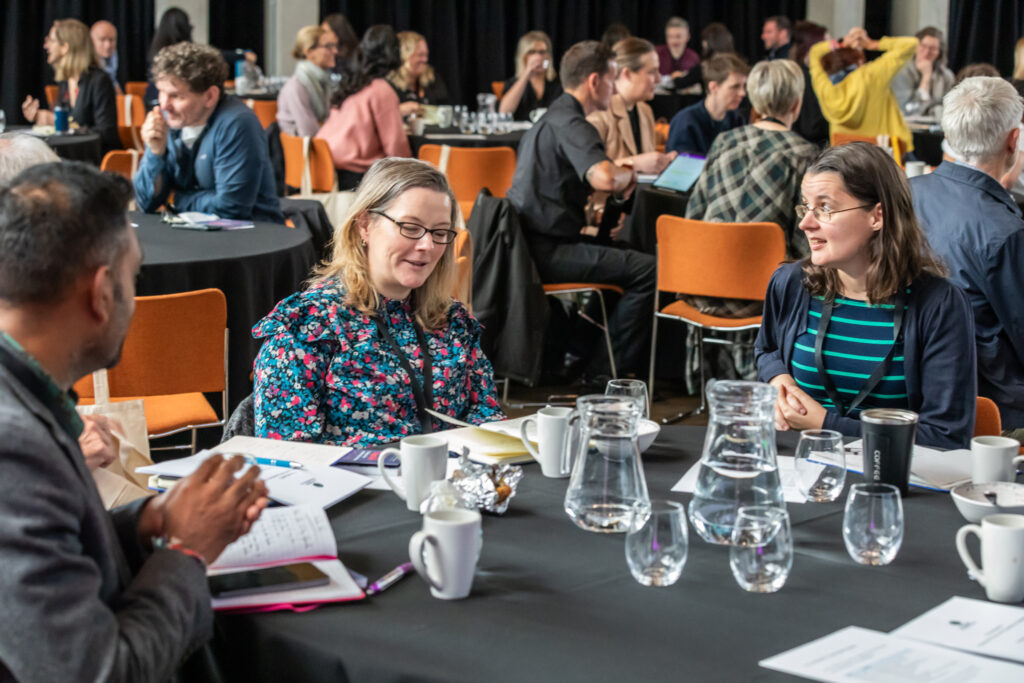
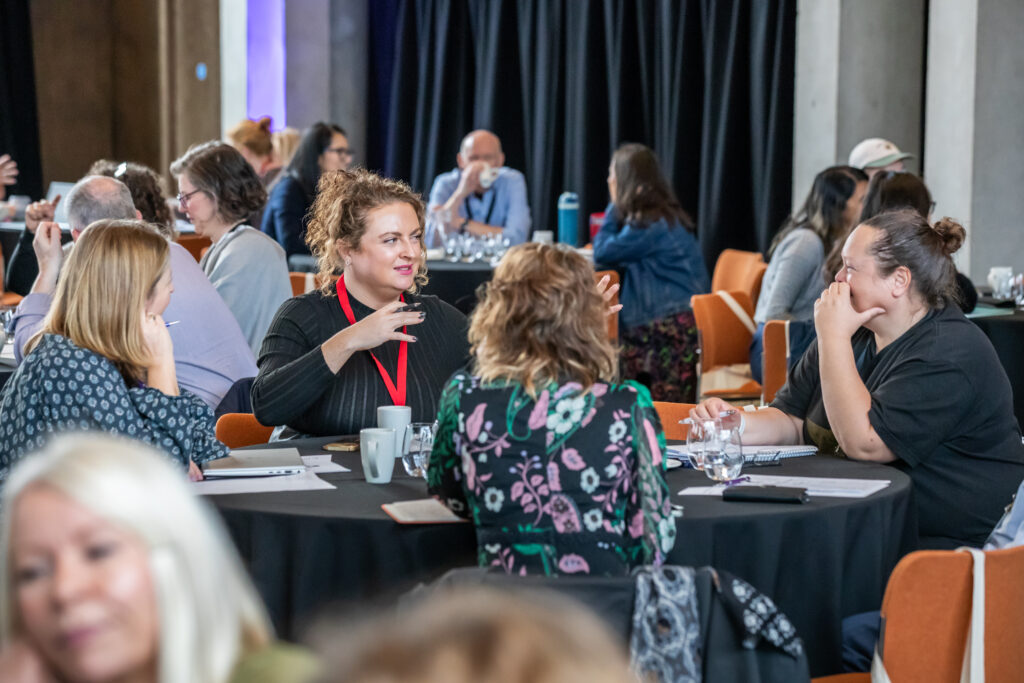
For the Prevention#25 Futures Triangle exercise, participants were grouped into tables, with each table working with a thematic lens.
The full set of themes used were:
- People Powered Prevention – Building the Workforce for Change
Skills, roles, confidence, capacity, wellbeing and permission for the workforce to work preventatively and collaboratively. - Leading Together – Collaboration as a System Superpower
Collective leadership, shared authority, trust, power-sharing and leading across boundaries rather than through hierarchy. - Data That Connects – Linking Insight to Action for Prevention
Data linkage, interoperability, real-time or near real-time insight, and turning data into action rather than reports. - Evidence That Counts – Learning Our Way to Prevention
What kinds of evidence are valued, how learning happens in complex systems, and how insight travels between practice, policy and strategy. - From Counting to What Counts – Measuring for Prevention
Outcomes vs outputs, long-term value, prevention-relevant metrics, and moving beyond narrow performance regimes. - Governance for Change – Accountability That Enables Prevention
Governance, accountability, risk, scrutiny and assurance arrangements that support learning, adaptation and shared responsibility. - Funding the Future – Resourcing Prevention for the Long Haul
Investment models, budgeting, pooling resources, long-term funding and financial rules that currently inhibit or could enable prevention. - Power in Place – Embedding Community Voice in System Change
Lived experience, community power, co-design, place-based working and shifting who shapes decisions. - The Prevention Mindset – Culture as the Catalyst
Values, beliefs, norms and behaviours: moving from control to trust, certainty to inquiry, and reaction to anticipation. - The Prevention System – Aligning Power, Purpose and Practice (Meta-theme)
How all of the above interact as a system; alignment (or misalignment) between structures, incentives, culture and intent.
What a prevention-focused future could look like
The Futures Triangle exercise at Prevention#25 surfaced a rich and sometimes uncomfortable picture of where Scotland’s prevention ambitions are being held back, where momentum is building, and what a genuinely prevention‑focused future could look and feel like. Rather than isolated issues, participants consistently described patterns across leadership, workforce, data, governance, funding and culture, all interacting as part of a wider system.
Looking back, the weights of the past were not framed as resistance to prevention in principle, but as deeply embedded ways of working that continue to shape behaviours. Across themes, participants spoke about systems designed around crisis response, risk aversion and short‑term performance, reinforced by siloed governance, narrow accountability, and funding models that reward activity rather than outcomes. In workforce and leadership discussions, this showed up as people feeling constrained: skilled, committed professionals operating within structures that limit permission to act collaboratively, to use judgement, or to work upstream. In data and measurement conversations, the past was felt through fragmented systems, weak linkage, and metrics that count what is easy rather than what matters for prevention.
The pushes of the present reflected growing strain but also growing clarity. Rising demand, fiscal pressure, workforce fatigue and widening inequalities were described not just as challenges, but as signals that the current model is no longer viable. At the same time, participants pointed to important enablers already in play: stronger cross‑sector relationships, increased comfort with collaboration following the pandemic, a clearer public health framing of prevention, and a growing appetite for shared learning rather than isolated “best practice”. Across themes, there was a sense that the system is being pushed towards prevention by necessity as much as by values.
Most compelling were the pulls of the future. These were not abstract visions, but grounded descriptions of what a prevention‑focused system would enable in practice. Participants imagined leadership that is collective rather than positional; a workforce supported to work relationally across boundaries; data that connects insight to action in near real time; governance that enables learning and adaptation rather than compliance; funding that backs long‑term outcomes; and communities positioned as partners with power, not just consultees. Culture was repeatedly named as the connective tissue — a shift from control to trust, from certainty to inquiry, and from organisational optimisation to whole‑system impact. Importantly, these futures were described as mutually reinforcing: no single theme can move in isolation without the others shifting too.
Taken together, the Futures Triangle revealed prevention not as a programme or policy choice, but as a system condition. Progress depends less on individual initiatives and more on whether the underlying structures, incentives and capabilities are aligned to support prevention as the default way of working.
Scottish Prevention Hub workstreams
Building on this work, the Scottish Prevention Hub is now undertaking deeper analysis and connected activity across each of the discrete Futures Triangle themes, drawing links between them and convening further conversations with partners, practitioners and communities.
This work is being taken forward alongside the Hub’s six workstreams ensuring that futures insights are not held separately from delivery, data, research, learning and leadership development.
Our six core workstreams are designed to shift public services from reactive response to prevention-first ways of working:
- Data Collaboration
Building the conditions for secure, ethical and purposeful data collaboration across sectors. This includes improving data linkage, interoperability and governance so that insight can be shared and used to support early, preventative action. - Research & Evidence
Connecting academic research, applied analysis and practice-based evidence to prevention challenges. The focus is on generating insight that is useful for decision-making, policy and service redesign, not research for its own sake. - Place-Based Insights
Working with local areas to understand how prevention plays out in real places. This includes bringing together local data, lived experience and practitioner insight to support place-based, whole-system responses. - Collaborative Leadership
Building the skills, relationships and leadership capabilities needed to work effectively across organisational and sectoral boundaries. This workstream focuses on collective leadership, systems thinking and collaboration in complexity. - Learning & Evaluation
Embedding learning and evaluation into prevention activity from the outset. The emphasis is on learning as we go in complex systems, understanding what contributes to change, and improving practice over time. - Sustainable Structures
Exploring the structural conditions required to sustain prevention over the long term. This includes governance, funding, accountability, data infrastructure and institutional arrangements that either enable or inhibit a prevention-focused public service system.
One workstream in particular – Sustainable Structures – cuts to the heart of what participants were grappling with. It raises fundamental questions about the conditions that must be in place to sustain prevention over time: what kinds of governance, funding, accountability, data infrastructure and institutional arrangements are required; and what needs to change so that prevention is not dependent on exceptional people or short‑term projects, but is embedded into how public services operate in Scotland. Exploring this space is central to moving from ambition to durability, and to creating a public service system where today’s decisions consistently create better futures.
This thought piece is also available in a narrative summary PDF format, which you can download here:
Prevention#25 Futures Triangle – Narrative Summary