

We are a research collective dedicated to exploring and representing the character of places and the people, institutions and infrastructures that make them.
Our approach prioritises the technological, material, historical, institutional, and sentimental qualities of places, how they are made and how they are experienced. Taking our lead from Edinburgh’s pioneering planner, landscape architect and sociologist, Patrick Geddes, we designed the Data Civics Observatory to use innovative data and platforms, methods and media to research space and place in new ways.
Our aim is to work with people, communities and organisations to research and represent their diversity and expertise particularly in vibrant and challenged areas. We focus on how data-driven innovations can shape the way we see and govern cities, regions and nations.
We explore place-based challenges from social inclusion, spatial inequality and community representation to tourism and traveltech, levelling up policy and the financing of net-zero infrastructure. We use data drawn from social media, locative media platforms, archives, democratic innovations, and digital ethnography to inform our research, knowledge exchange and teaching. The results are shared in a wide range of media including publications and reports, film and photography, websites and exhibitions. In collaboration with the Postgraduate Researcher run project, The Platform Social, we run a range of seminars, workshops and events. These activities support and explore the broader CAHSS research themes of cities, governance and democracy, identity and inequalities, cultural heritage, and data & digital.
Fundamentally, the Data Civics Observatory is about exploring how data driven innovations can enhance interdisciplinary knowledge, collaborations and relationships between the University, EFI, the Edinburgh and South East Scotland City Region and beyond.
“The Data Civics Observatory is about putting Patrick Geddes’ ideas to work in a twenty-first century context, where what we know about cities, how we live within them, govern them and plan for their futures comes from data-driven innovations, from technologies and internet platforms.”
Liz McFall – Director, Data Civics Observatory
In focus
Reviving the commons? A scoping review of urban and digital commoning

This report explores the contemporary revival of commoning practices in urban and digital contexts. The authors, James Henderson and Oliver Escobar, delve into the historical roots, current manifestations, and future potential of the commons as a paradigm for socioeconomic transformation, democratic innovation and sustainable community governance.
Community Leadership in North Edinburgh: Report from the Knowledge Exchange Labs 2022
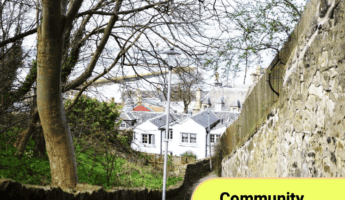
Edinburgh Futures Institute’s (EFI) Data Civics team was funded by the UK Economic and Social Research Council (ESRC) to undertake knowledge exchange and shared learning with local bodies in North Edinburgh – drawing on previous research on both community empowerment and digital cultural regeneration.
REIMAGINING REGENERATION – SUPPORTING LOCAL ACCELERATION THROUGH DATA-DRIVEN PARTICIPATORY ENGAGEMENT

Edinburgh Futures Institute’s Granton project team are working with the City of Edinburgh Council, community organisations and other stakeholders to help imagine futures which address local needs, using data-driven technology.
Projects



Films and the AWED (AreWeData) collective
AWED were brought together by accident and a shared interest in making films, installations, texts and other web-based artefacts, that explore the use of new forms of ‘big data’ and old forms of archival data in how places are imagined, represented and planned.


A processual exploration of Airbnb
If how we see a place is a product of where we stand and what tools we use to look, Airbnb is an intriguing case for the Data Civics Observatory. Addie McGowan’s doctoral research explores the processes of Airbnb and how they reconfigure our sense of place, both online and off.

Reviving the commons? A scoping review of urban and digital commoning
This report explores the contemporary revival of commoning practices in urban and digital contexts. The authors, James Henderson and Oliver Escobar, delve into the historical roots, current manifestations, and future potential of the commons as a paradigm for socioeconomic transformation, democratic innovation and sustainable community governance.

Events
Digital Method of the Month: What LLMs Can and Cannot Do
The digital method of the month meeting is a safe space to freely discuss the practicalities of learning and implementing a new digital skill in your research. During this session, we will introduce the concept of Large Language Models (LLMs), discuss their strengths and weaknesses, and explore how they can be effectively integrated into research workflows.
Getting Started with Python for Research
This course will introduce attendees to the basic concepts and features of Python programming language. The goal is for participants to feel comfortable with creating simple Python programs and provide them with the autonomy and confidence required to progress independently.
Getting Started with R for Research
This beginner-friendly course will focus on developing skills and a fundamental understanding of R and RStudio. Participants will develop a familiarity with the principles and functionalities of R and RStudio, allowing them to confidently apply these, or indeed seek out new concepts, for their current and future research.
Network Analysis from Scratch: Intro to Gephi
This three-session course introduces attendees to Gephi, a free and open-source network analysis and visualisation tool. The main focus will be on social network analysis, and attendees will have the opportunity to apply their own dataset in Gephi.
Digital Method of the Month: Geospatial Data and GIS
The digital method of the month meeting is a safe space to freely discuss the practicalities of learning and implementing a new digital skill in your research. The method of this month is GIS, or Geographic Information Systems. GIS is a computer system that combines maps and databases to help people create, manage, and analyse information about places.
From Images to Text: Working with OCR
This course is an introduction to extracting text from images and scanned PDFs using Optical Character Recognition (OCR) techniques. In the course, we will give you an overview of text extraction, demonstrate how OCR works in practice, using free, ready-to-use tools that are widely available.
Collecting Data from the Web: Foundations of Webscraping
This workshop introduces the fundamentals of scraping user-generated content from the web using R or Python. The session will be hands-on, working through the process of scraping a selected static website step by step, before concluding with a discussion of the limitations of scraping and the challenges posed by more complex dynamic sites.
Digital Method of the Month: Data Visualisation
The digital method of the month meeting is a safe space to freely discuss the practicalities of learning and implementing a new digital skill in your research. A big part of conveying research results hinges on how these results are presented. Join us to discuss the main principles of effective and reproducible data visualisation.
Introduction to Geographical Data with QGIS
This course will focus on developing skills and a fundamental understanding of Geospatial data and the basic functionalities of QGIS. Each session begins with a presentation that introduces the theoretical principles and is followed by a guided practical exercise where these principles can be tested and applied, as well as developed upon. Please bring a mouse with you to the session.
Silent Disco: Foundations of Sentiment Analysis
Sentiment analysis is the process of determining whether a piece of writing is positive, negative or neutral. Its use has become relatively widespread, including being used to analyse customer feedback, social media, user surveys, and more. This workshop will cover how it works; pros and cons; using it on text, user feedback and online sources.
Using API for Research
In this course we will cover what application programming interface (API)s are, what they do, how to use them to access and connect data sources. We will also discuss practical considerations such as rate limits, authentication, and the availability of APIs for researchers.
Getting Started with Descriptive Statistics
This workshop will focus on developing practical skills for summarising and exploring data using R or Python. The session will introduce key concepts in descriptive statistics, including measures of central tendency, measures of variability and data distributions.
Silent Disco: Working with Named Places: How and Why to Build a Gazetteer
This lesson teaches how to create a digital gazetteer from a historical text using the Linked Places Delimited (LP-TSV) format. A gazetteer records place names, spatial extents, and historical data, offering a structured knowledge system to connect places, events, and people across time. It is a key tool for spatial history and digital humanities.
Using Prompting Efficiently for Research
This workshop aims to introduce the main strategies of prompt engineering including tips and certain practices to achieve optimal outputs with Generative AI (Gen-AI) tools. After providing a hands-on overview of prompt engineering, certain features of ChatGPT will be discussed for fostering the research practices.
Build Your Personal or Project Website with GitHub Pages
GitHub Pages is a free service that includes different website templates and is used by many academics for personal and project websites. While it requires some programming skills, it is easy to set up and highly customizable. During this course, we will help you set up your own website with GitHub pages, add content to it, and make small design changes if desired.
Working with Archive Data (pictures of text, scanned files, PDFs)
The workshop will focus on developing a batch-processing workflow rather than processing documents individually. By the end of the workshop, participants will have a better understanding of how to use Python to transform scanned documents and image-based PDFs into searchable text.
Digital Method of the Month: Software Development with Generative AI
The digital method of the month meeting is a safe space to freely discuss the practicalities of learning and implementing a new digital skill in your research. During this session we will discuss trade-offs regarding gains in productivity and the dangers of producing executable code; how the development of these tools changes the nature of learning to code; as well as best practices and strategies for exploring this safely.
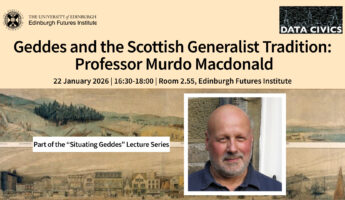

Event reviews
Limits and Frontiers of Insurance Workshop
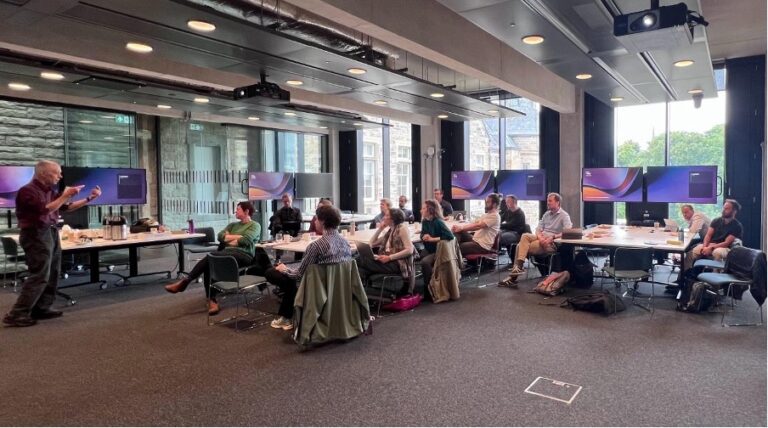
Edinburgh Futures Institute welcomed researchers in the social studies of insurance to a two-day workshop, co-hosted by EFI’s Data Civics Observatory Director, Liz McFall, Financial Services and FinTech Sector Engagement Lead, Tobi Schneider, and Turo-Kimmo Lehtonen of Tampere University.

Our extended team
Our wider network of researchers, artists, designers, and partners
- Darren Umney
- David Moats
- Edinburgh Palette
- Granton Hub
- Granton Waterfront Programme, City of Edinburgh Council
- James Henderson
- North Edinburgh Arts
- Sapphire Goss
- Screen Edinburgh
- Simon Phipps