
This article first appeared on The Courier on 22 May 2026.
Health in Scotland is rarely out of the headlines. Waiting times, workforce pressures and the sustainability of the NHS dominate public debate. But beneath these immediate concerns lies a deeper and more uncomfortable truth: health inequalities in Scotland are not simply about healthcare delivery; they are about place and power. Unless that is confronted, efforts will continue to treat the symptoms rather than the causes.
I have seen this dynamic play out when I worked abroad.
In the Democratic Republic of Congo, I saw first-hand how fragile health systems reflected deeper imbalances between central and local government, between communities and institutions, and between those with resources and those without.
Urban areas consistently benefited, not only because of infrastructure, but because of their proximity to power and decision-making. These dynamics shaped how resources were distributed. Donor funding, while vital, often reinforced these patterns – for example, drawing healthcare workers and investment into funded programmes and locations, leaving other areas comparatively underserved.
Too often, the voices of communities themselves were absent from decisions about the services intended to support them.
Having returned to work in Scotland, I’m struck by how familiar the pattern between health, place and power feels.
Inequalities remain stark; men in Levenmouth live on average 10 years less than men in north-east Fife. These are not marginal differences; they are structural.
And yet, public understanding of health still often defaults to individual behaviour. Of course, our lifestyle matters – whether we drink too much, smoke, etcetera – but it is only part of the story.
Focusing solely on behaviour risks obscuring the conditions in which those behaviours occur.
Health is very much shaped by place: by whether you live in warm, secure housing; by whether you have a stable income; by whether your environment makes healthy choices easy or difficult.
Recent debates on obesity in Scotland have reflected this, with calls to move beyond medical solutions and instead reshape the environments that drive unhealthy outcomes.
But place itself is shaped by power. Decisions about where investment is directed, how services are designed, and which priorities are advanced all influence the distribution of health.
Some communities are better positioned to influence these decisions than others. This uneven distribution of influence contributes directly to unequal outcomes.
Scotland has long recognised the need for a “preventative shift” to address these challenges. Prevention is often understood as earlier intervention – identifying risks sooner and acting before problems escalate.
But in its fullest sense, prevention is about something more fundamental: changing the distribution of power and resources that produce ill health in the first place.
Despite consistent rhetoric, progress has been limited. Strategies, frameworks and reforms have repeatedly emphasised prevention and tackling inequalities, yet outcomes have been slow to change. This reflects a more difficult reality: without shifting power, efforts to reduce inequalities will continue to struggle.
A more substantive shift in power would involve strengthening community influence in decision-making.
The most effective public health interventions – whether in Kinshasa or Kirkcaldy – are those that are designed with communities, not imposed upon them. This requires genuine participation, not consultation as an afterthought.
Second, it would mean using the full range of policy levers beyond health.
Housing, employment, education, transport and the environment are not peripheral to health – they are central. The Population Health Framework rightly recognises this, but delivery requires alignment across government, not just ambition.
Third, it requires being honest about trade-offs and redistribution. Addressing inequalities will require shifting investment upstream, even when pressures downstream are acute. But it also means applying universal policies with a scale and intensity proportionate to need. We all know that people’s starting points are unequal, but it requires political courage to actively level the playing field.
There is reason for optimism. Scotland has a strong policy architecture, a clear commitment to prevention, and growing recognition of the importance of social determinants of health. But progress will depend on whether we are willing to go further, to address not just place, but power too.
Health inequalities are not inevitable. They are shaped by decisions about resources, priorities and whose voices are heard.
Improving health therefore requires more than reforming services; it requires a shift in how power is understood and exercised across the system. Until that shift happens, the gap in health outcomes between communities will remain – not because it cannot be closed, but because the conditions that sustain it have yet to be fully addressed.
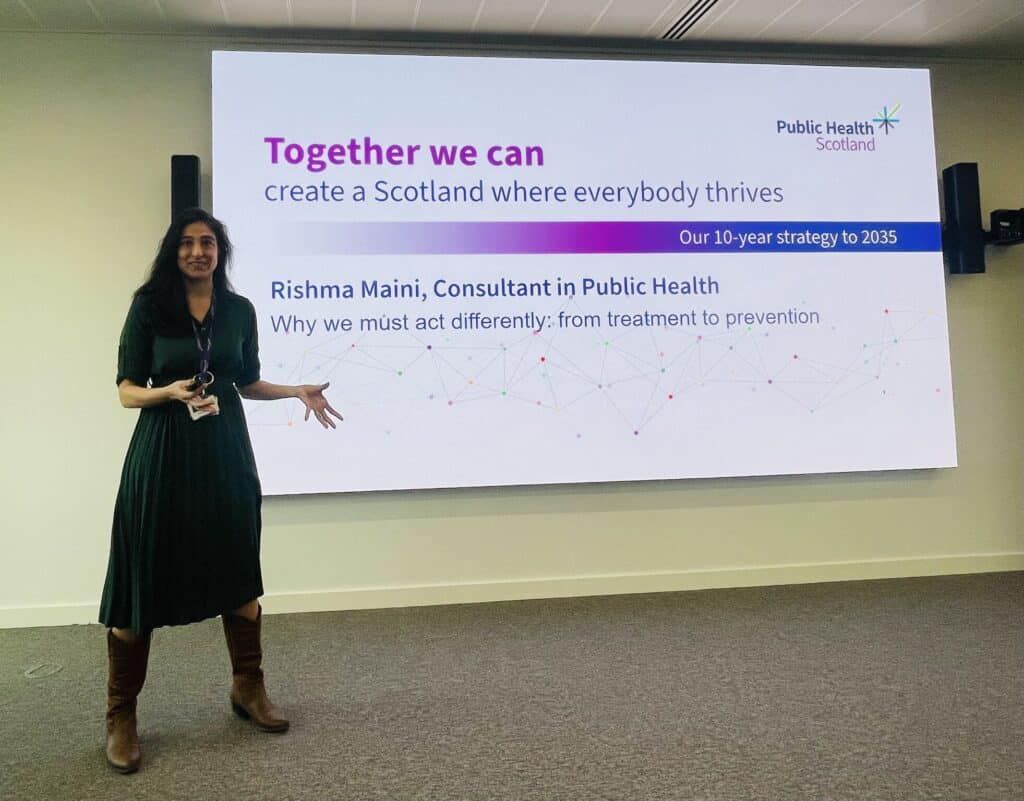
Dr Rishma Maini is a qualified Consultant in Public Health Medicine with over 15 years of experience across domestic and international public health. She currently holds a joint role with Public Health Scotland and NHS Fife and works closely with the Scottish Prevention Hub at Edinburgh Futures Institute. She has been a key strategic leader within the Hub, helping to shape the development of the Common Data Platform for Scotland and championing the use of data, evidence and cross-sector collaboration to support prevention-focused policy, practice and system change.